
Game Dev Story
KairosoftSimulation
4.78.45K Reviews
- Version
- 2.6.9
- Installs
- 1.00M
- Age Rating
- Everyone
Screenshots
Our Review of Game Dev Story
 Analysis by Appyee
Ever dreamt of running your own game development company? Well, with Game Dev Story, you can dive into the world of gaming entrepreneurship right from your smartphone. I recently gave this quirky simulation game a whirl, and let me tell you, it’s as addictive as it is charming. Let’s break it down.
Who will enjoy building a small studio?
I’d point this game toward anyone who likes watching several modest decisions add up to a result. It turns a development studio into a manageable little operation: hire people, choose what to make, guide the work, and see how the release performs. The appeal is less about mastering a realistic business simulator than about learning a compact loop and trying to improve on your last decision.
That makes it a comfortable fit for short sessions. I can imagine opening it while waiting for an appointment, choosing a project, and checking back when I have a few more minutes. It also suits players who enjoy gentle experimentation more than constant action. If your ideal simulation is a fast-moving city builder, a detailed management spreadsheet, or a hands-on game-making tool where you write code and build levels, this is not trying to be any of those. Its pleasure comes from steering a fictional company, not creating a playable game outside the simulation.
Readable ideas, compact presentation
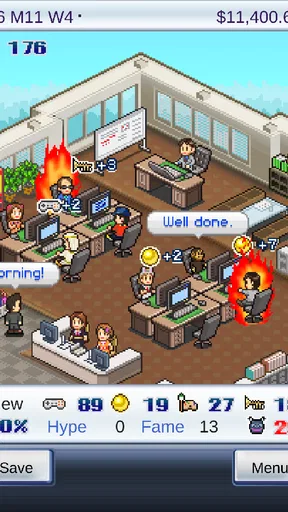
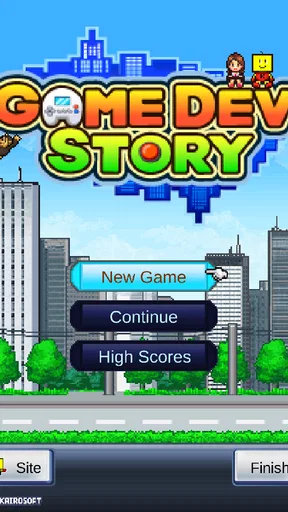
Jumping into Game Dev Story is like stepping into a retro arcade, complete with pixelated graphics and a catchy chiptune soundtrack. The game kicks off by giving you the reins of a fledgling game development company. Your mission, should you choose to accept it, is to build it into a gaming empire.
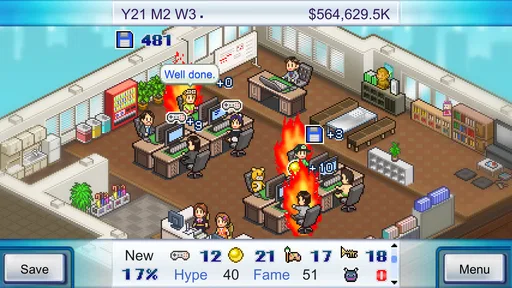
The pixel-art look gives the studio and its employees a clear, consistent identity, and the subject matter is easy to grasp even if you have never worked in game development. You are not expected to understand production jargon before you start. I find that approachable framing useful: the game presents its decisions as part of a playful business story rather than a technical lesson. At the same time, small characters and compact screens are part of the presentation, so players who need larger text or high-contrast visuals may find the style less comfortable than a modern interface designed around those needs.
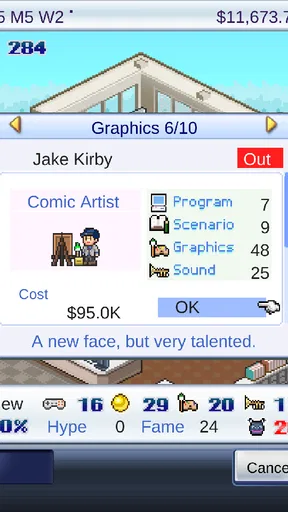
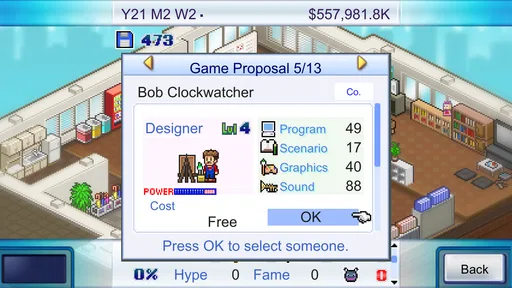
You start by naming your company and hiring a few basic employees. Each character comes with their own set of skills, and it's up to you to decide who fits best in your team. This part of the game feels a bit like assembling a ragtag crew in a heist movie, and honestly, it’s pretty fun.
For a useful early habit, I would look at the people you already have before treating every new hire as an automatic upgrade. The staff’s skills matter because development asks you to distribute effort across different areas; a team that looks impressive on paper is not necessarily the one that covers the needs of your next project best. That small bit of planning gives hiring a purpose beyond simply collecting characters.
Getting Started with Your Pixelated Empire
I’d begin by treating the first stretch as a chance to learn the studio’s rhythm, not as a test you need to ace immediately. I find it more useful to notice how staffing, production choices, and the company’s funds affect one another than to chase an impressive launch at once. That gives the next decisions a clearer purpose and makes the early experiments easier to enjoy.
Developing Your First Game
Once you've got your team, it's time to create your first game. This is where the magic happens. You choose a genre and a theme, which leads to some hilarious combinations. Ever wanted to make a Ninja Puzzle game? Go for it! The possibilities are endless, and experimenting is half the fun.
The combinations are a good reason not to settle on a single comfortable formula. Trying a pairing that sounds odd can be entertaining in itself, while comparing the results of different choices gives you a simple way to learn what suits your approach. I would treat early releases as experiments rather than expecting every one to become a runaway success. That mindset makes a weak result feel informative instead of like wasted effort.
The development process involves balancing the allocation of your staff’s skills across different phases like coding, sound, graphics, and more. Make sure to keep an eye on your budget, though! Money management is key here, and running out of funds can put your dream game on ice.
This is where patience helps. It can be tempting to spend freely because a new project feels exciting, but the studio’s finances are part of the challenge, not a side detail. I would avoid treating every possible improvement as mandatory; consider what the current team can reasonably support, then keep enough flexibility to continue after the release. The trade-off is clear: investing in a more ambitious effort may feel rewarding, but a smaller, better-managed plan can be the safer choice when the company is still finding its feet.
Marketing and Sales
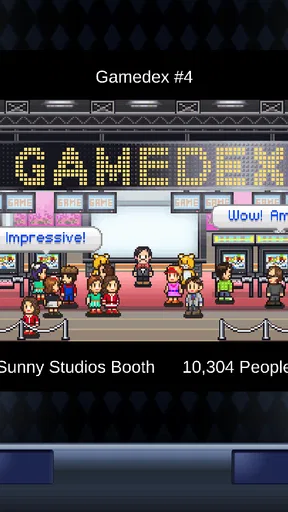
Once your game is ready, it's time to market it. This part of the game adds another layer of strategy. You can choose to advertise through magazines, attend gaming expos, or even hire a famous game designer for a cameo. Each decision impacts your game’s success differently, and watching your sales numbers tick up is incredibly satisfying.
Because promotion is a choice rather than an automatic finishing touch, it is worth thinking about the whole release instead of spending impulsively at the last moment. I like that the game connects making a product with trying to attract an audience; it gives the business theme more shape than a simple sequence of projects. Still, anyone looking for precise real-world marketing lessons should keep expectations modest. These are playful management decisions, not a guide to running an actual studio or predicting a real game’s sales.
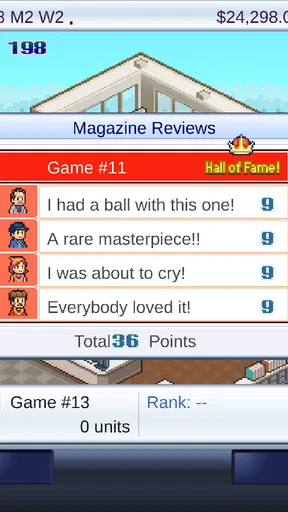
Seeing your creation rise in the ranks, win awards, or even become a top seller is rewarding. But don’t get too comfy; the gaming world is competitive, and you’ll need to keep innovating to stay ahead.
How it fits into an everyday routine
A realistic way to play is to start a session with one clear intention: review the studio, decide whether the next priority is staffing or a new release, and then make the project choices you can afford. If you have to put the phone down, the game’s management pace is easier to return to than an action game that expects continuous attention. I would still avoid starting a new project when I only have a moment to spare if I want time to follow its decisions rather than tapping through them quickly.
The game is also a better choice for relaxed, self-directed play than for social competition. Its central pleasure is seeing your own company develop, so it suits a commute or a quiet break when you want a small ongoing project. If you want live multiplayer, quick rounds against friends, or a story that carries you through a fixed sequence of scenes, a different kind of game will serve that mood better.
Why It’s So Addictive
The beauty of Game Dev Story lies in its simplicity and depth. The game’s pixel art style is charmingly nostalgic, and the mechanics are straightforward enough for anyone to pick up. Yet, there’s a surprising amount of depth to managing your team, budgeting, and planning your next big hit.
For me, the hook is the connection between decisions: staff choices affect what the team can do, production requires managing money, and a finished game still needs attention if it is to find an audience. This makes the studio feel like a system rather than a menu of unrelated activities. The trade-off is that the basic rhythm can become familiar. Players who want frequent mechanical surprises or finely detailed control over every production task may eventually prefer a larger, more demanding management game.
Fans of simulation games will appreciate the layers of strategy involved. Plus, the game’s humor and lighthearted approach keep it from ever feeling like a grind. Expect to lose track of time as you tweak your game development formula to perfection.
Controls, comfort, and access in different settings
Since this is a mobile simulation rather than a reflex-focused action game, its appeal does not depend on rapid combat inputs. That can make it a more comfortable option for someone who prefers planning and tapping through management choices. Still, touch interaction is central, and the compact pixel-art presentation may not work equally well for every player. I would not assume that the relaxed pace removes motor or visual barriers; comfort depends on how easily you can use the phone and read its screen.
Sound is part of the retro character, but the game’s core appeal is also in following the studio’s decisions and outcomes. That makes it a reasonable candidate for a quiet setting where you would rather keep audio low, though I would not claim every cue has a visual substitute. If you play in a noisy place, or need to keep your device muted, consider whether you enjoy management games whose main feedback comes from watching the screen rather than relying on sound.
What to expect before you buy
Kairosoft made this paid simulation, priced at $4.49, and its audience rating is 4.7 from around 82,000 ratings. It has passed a million installs, while the age classification is Everyone. Those figures suggest broad interest, but they do not tell you whether its specific pace and old-school presentation match your taste. I would buy it for the focused studio-management loop, not because I expect a free-form development toolkit or a realistic business course.
The game was released on December 10, 2010, and the current version is 2.6.9, with Android 6.0 as the minimum operating system. That long-running, retro feel is part of its identity, but it also means players seeking a contemporary-looking interface may prefer a newer simulation. On the other hand, someone who likes compact pixel-art games and straightforward management has a clear reason to consider it.
Compared with the usual alternatives in the simulation category, this is a narrower, more playful take on running a business. A city or farm simulator tends to focus on expanding a place and tending its resources; here, attention stays on a studio, its staff, its productions, and the fortunes of its releases. That narrower scope is a strength if you want a theme with a clear loop, but a limitation if you want a large world to build or a highly realistic company model.
Final Thoughts
If you’ve ever wanted to experience the thrill of creating a hit game, Game Dev Story is a delightful way to do it. It strikes a perfect balance between accessibility and complexity, making it a must-try for gamers and wannabe developers alike.
I would qualify that recommendation for anyone who needs larger text, extensive accessibility options, or detailed control over how information is displayed: the game’s compact retro style may not be the easiest fit. I would also skip it if you dislike repeated management loops, want to make a real game yourself, or expect a simulation to teach practical industry methods. For players who want a light business fantasy with staff decisions, budget trade-offs, and a steady stream of new projects, it offers a distinctive little world to manage.
So, if you're ready to build your own gaming empire, give Game Dev Story a download. Just be prepared—it’s a bit like digital potato chips; once you start, you might not be able to stop!
Verdict
Strengths of Game Dev Story
- Simple yet addictive gameplay.
- Charming retro graphics.
- Engaging storyline progression.
- Wide range of game development options.
- Smooth learning curve.
Limitations of Game Dev Story
- Repetitive tasks can feel tedious.
- Limited character customization.
- Can become easy after mastering.
- Lack of multiplayer features.
- Occasional slow pacing.
Other Releases by Kairosoft
View All
Hot Springs Story 2
Casual4.7

Pocket League Story
Sports4.1

Grand Prix Story
Sports4.4

Basketball Club Story
Sports4.7
Similar Picks in This Category
View All
Truckers of Europe 3
Wanda Software4.3

Town Building Life Simulator
XGame Global4.2

Fidget Toys Trading・Pop It 3D
Freeplay Inc4.7

Sculpt People
CrazyLabs LTD4.4

Scary Teacher 3D
Z & K Games4.2

Hair Tattoo: Barber Shop Game
CASUAL AZUR GAMES4.3
Frequently Asked Questions
What is the main objective of Game Dev Story?
Game Dev Story is a simulation game where players take on the role of a game development studio manager. The primary goal is to create successful video games, manage staff, and grow your company into a top-tier development studio. You'll need to balance creativity, budgeting, and marketing to achieve success.
How does the hiring system work in Game Dev Story?
In Game Dev Story, you can hire staff by using in-game resources to search for potential candidates. Each candidate has different skills and salary demands. It’s crucial to hire a balanced team with various specialties like programming, graphics, and sound to create high-quality games and improve your studio's efficiency.
Can I customize my games in Game Dev Story?
Yes, customization is a key feature in Game Dev Story. Players can choose the genre, type, and platform of the games they create. Additionally, you can allocate resources to different aspects of development, such as graphics and sound, to tailor the game to your target audience and market trends.
Is Game Dev Story suitable for casual gamers?
Game Dev Story is well-suited for both casual and dedicated gamers. Its intuitive controls and engaging gameplay make it easy for newcomers to enjoy, while its strategic depth offers a rewarding experience for those who enjoy management and simulation games. The game’s pace allows for flexible play sessions.
Are there any in-app purchases in Game Dev Story?
Game Dev Story is a premium app, meaning you pay once upfront to download it. There are no in-app purchases or microtransactions, allowing players to enjoy the full experience without additional costs. This makes it a great choice for users who prefer straightforward, complete gaming experiences.
Play our best games!


